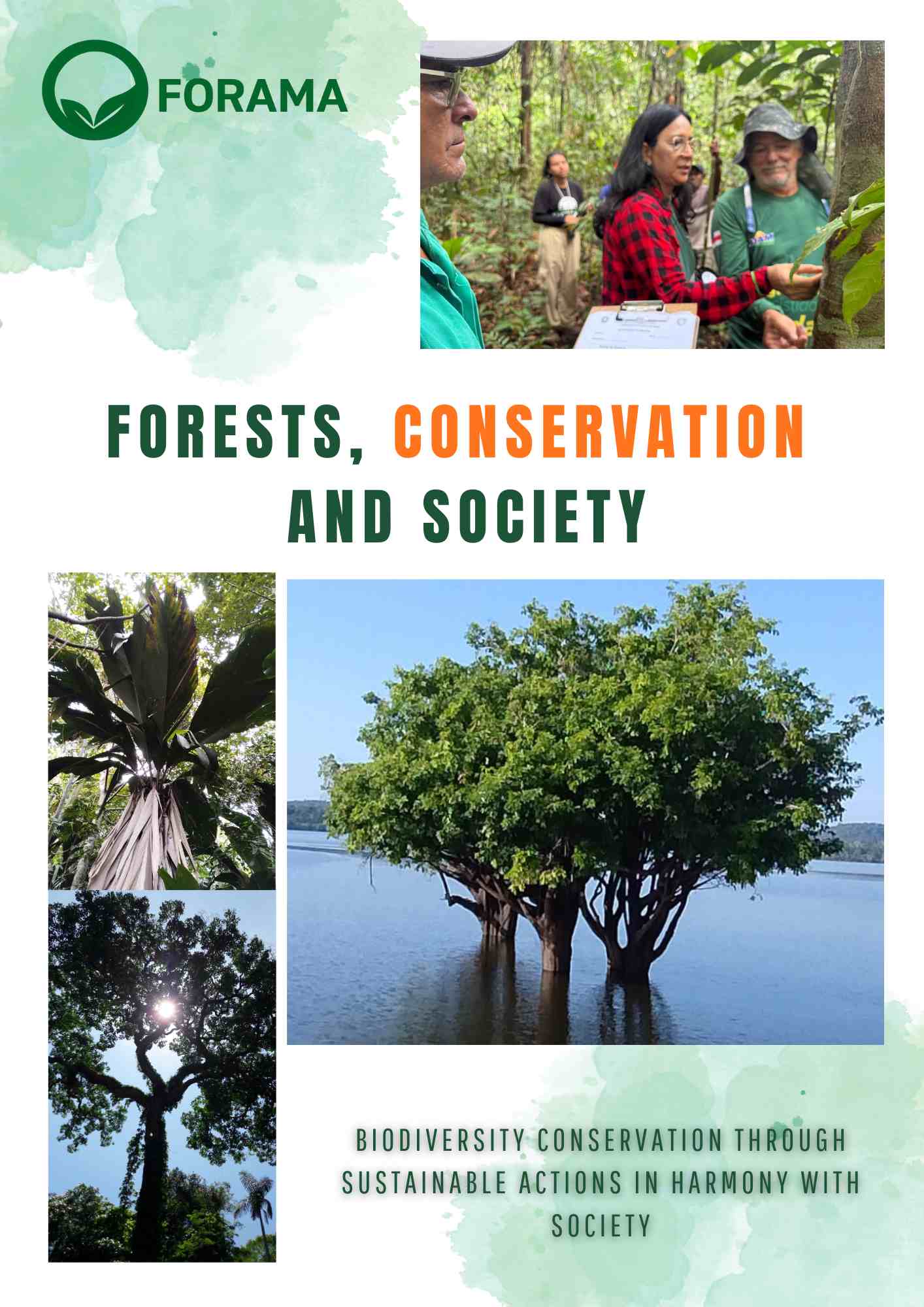
Forests, Conservation
and Society
"Advancing science, policy and practice for resilient forests and societies."
About the journal
Forests, Conservation and Society is an international, peer-reviewed scientific journal published by the Fundación Flora Amazónica (FORAMA). The journal is dedicated to advancing interdisciplinary research on forest conservation, sustainable management, and socio-ecological resilience, with a particular emphasis on Amazonian forests as globally strategic ecosystems.
The journal provides a platform for high-quality scientific contributions that integrate ecological science, forest management, climate change research, biodiversity conservation, socio-environmental governance, and community-based approaches. We seek to bridge the gap between academic research, public policy formulation, and on-the-ground practices, fostering evidence-based decision-making for forest-dependent regions.
The journal promotes open access to scientific knowledge, recognizing that equitable dissemination of research is essential for strengthening local capacities, supporting public policies, and enhancing global understanding of forest systems under rapid environmental and social change.
Aims
Forests, Conservation and Society aims to publish scientifically rigorous and socially relevant research that contributes to the conservation, sustainable management, and restoration of forest ecosystems, particularly in tropical and Amazonian contexts. The journal prioritizes studies that enhance understanding of forest dynamics, ecosystem services, climate change mitigation and adaptation, and the interactions between forests and human well-being.
Scope & Thematic Areas
Forest Ecology and Sustainable Management
- Structure, composition, and dynamics of tropical and subtropical forests
- Sustainable forest management systems and reduced-impact logging
- Community-based forest management and territorial governance
- Forest landscape restoration and ecological connectivity
Climate Change, Carbon and Ecosystem Services
- Forest carbon stocks, biomass estimation, and allometric modeling
- MRV systems (Monitoring, Reporting and Verification) for forest carbon
- Climate change mitigation and adaptation strategies in forest landscapes
- Ecosystem services valuation and nature-based solutions
Biodiversity Conservation and Amazonian Resources
- Conservation of flora and fauna, including threatened species
- Functional diversity, species interactions, and habitat resilience
- Non-timber forest products and bioeconomy approaches
- Impacts of deforestation, forest degradation, and land-use change
Remote Sensing, Geospatial Analysis and Monitoring
- Application of GIS, remote sensing, LiDAR, and UAVs in forest studies
- Land-use and land-cover change analysis
- Environmental monitoring and early warning systems
- Predictive modeling and artificial intelligence applied to forest conservation
Social Dimensions, Indigenous Knowledge and Gender
- Indigenous, campesino, and traditional knowledge systems
- Gender equity and the role of women in forest conservation
- Social innovation, environmental education, and capacity building
- Participatory research and co-production of knowledge
Policy, Governance and Sustainable Development
- Forest-related public policies and legal frameworks
- Environmental governance, tenure systems, and land-use planning
- Science–policy interfaces and decision-support tools
- Sustainable development strategies for forest-dependent regions
Journal Distinctiveness
Forests, Conservation and Society distinguishes itself through:
Editorial Platform
Submission management, peer review, and access to the full editorial board are all handled through our OJS system.
Access OJS PlatformEditor-in-Chief

Ph.D. Edson Jose Vidal da Silva
Associate Professor at ESALQ/USP & Coordinator of LASTROP.
With a Ph.D. from USP and Post-doctoral studies at the University of Florida, Dr. Vidal brings over 30 years of experience, including 14 years as a researcher at IMAZON. His expertise covers Tropical Forest Management, Forest Certification, and Forest Dynamics.
Publishing Options
Articles are freely available to both subscribers and the wider public with permitted reuse.
Publication costs are fully covered by FORAMA Foundation.